
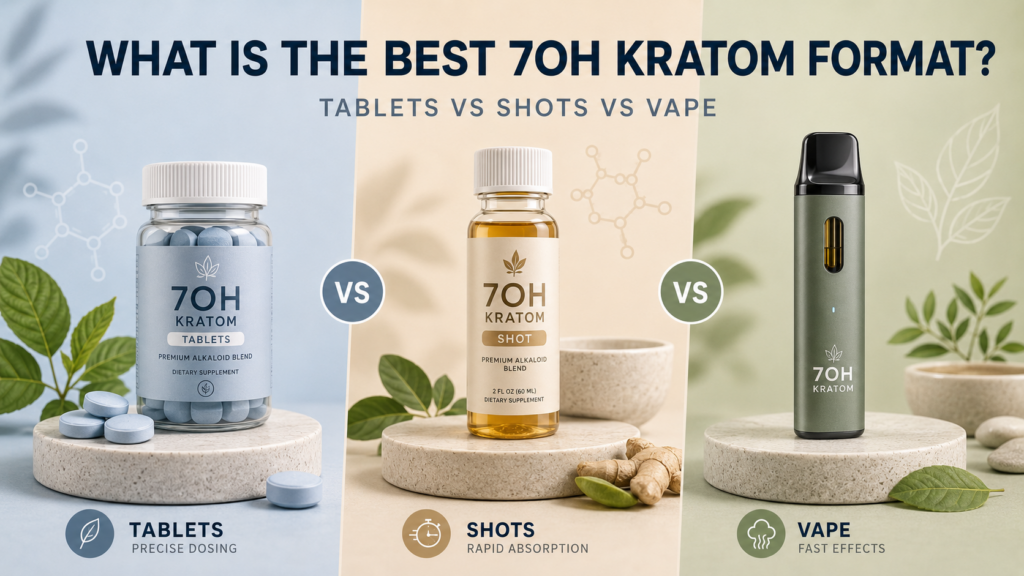
When shoppers compare 7OH kratom products, one question comes up quickly:
What is the best 7OH format: tablets, shots, or vape?
The answer depends on what you mean by “best.” Some people care most about portability. Others care about serving control, flavor, speed, price per serving, or label transparency. But with 7OH products, convenience should never be the only factor.
7OH, also called 7-hydroxymitragynine or 7-OH, is a kratom-related alkaloid. It occurs naturally in trace amounts in kratom, but many modern 7OH products contain added or enhanced levels of 7OH. The FDA recommends consumers avoid products containing 7OH and states that 7OH products have not been proven safe or effective for any use.
This guide compares 7OH tablets vs shots vs vape in simple terms so shoppers can understand how each format works, what to check on the label, and why product transparency matters more than hype.
Important note: This article is for educational purposes only. 7OH products are not FDA-approved to diagnose, treat, cure, or prevent any disease. This guide does not recommend using 7OH tablets, shots, vapes, or any concentrated 7OH product. Always speak with a licensed healthcare professional for health concerns.
Quick Answer: What Is the Best 7OH Kratom Format?
There is no single “best” 7OH format for everyone.
7OH tablets are usually the easiest format to compare because they often list a clear amount per tablet. 7OH shots may be convenient, but shoppers must check whether the bottle contains one serving or multiple servings. 7OH vape products require the most caution because vaping adds inhalation-specific concerns, and shoppers may not know whether the ingredient has been evaluated for inhalation.
|
Format |
Best For Comparing |
Main Buyer Concern |
|
7OH Tablets |
Potency per tablet, serving control, portability |
Check mg per tablet, serving guidance, and lab testing |
|
7OH Shots |
Liquid convenience and ready-to-use format |
Check servings per bottle and total active alkaloids |
|
7OH Vape |
Portability and fast-use marketing |
Check ingredient safety for inhalation, lab testing, and legal concerns |
The most practical answer is:
For label clarity, tablets are usually easier to compare. For convenience, shots may appeal to some shoppers. For safety transparency, vape products often raise the most questions.
What Is 7OH?
7OH stands for 7-hydroxymitragynine, a kratom-related alkaloid. While it occurs naturally in kratom at trace levels, the FDA’s warning focuses on products containing 7OH as an added ingredient or at enhanced levels. These concentrated products can include tablets, gummies, drink mixes, and shots.
The FDA has also stated that:
- There are no FDA-approved products containing 7OH.
- 7OH is not approved for any medical use.
- 7OH is not lawful as a dietary supplement.
- 7OH cannot be lawfully added to conventional foods.
- Consumers should avoid products containing 7OH.
Because of this, any comparison of 7OH formats should focus on education, label transparency, and safety awareness rather than claims about benefits.
Why Format Matters With 7OH Products?
The format can change how a shopper compares the product.
A tablet, shot, and vape may all be marketed around 7OH, but they can differ in:
- Serving clarity
- Portability
- Flavor
- Total package strength
- Speed-related marketing
- Storage and handling
- Lab testing expectations
- Legal and compliance risk
- Whether the product is swallowed or inhaled
Format also affects how easy it is to understand the label.
A tablet may say 25mg per tablet. A shot may say 300mg total active alkaloids per bottle but contain multiple servings. A vape may list total device content without clearly explaining per-use exposure.
That is why the best 7OH format is not just about convenience. It is about how clearly the product explains what is inside.
What Are 7OH Tablets?
7OH tablets are chewable or swallowable tablet-style products containing or marketed around 7-hydroxymitragynine.
They are commonly positioned as:
- Portable
- Easy to store
- Easy to compare
- More controlled than loose powders
- Available in different potency ranges
- Convenient for shoppers who prefer pre-measured formats
7OH tablets may come in different strengths, such as:
- 5mg – 25mg
- 25mg – 50mg
- 50mg – 75mg
- 75mg – 100mg
The FDA has specifically named tablets among the concentrated 7OH product formats of concern. In 2025, the FDA issued warning letters to firms marketing 7OH products, including concentrated tablets, gummies, drink mixes, and shots.
Pros of 7OH Tablets
From a buyer-comparison point of view, tablets can be easier to review because they often show:
- Milligrams per tablet
- Number of tablets per pack
- Suggested serving size
- Total package strength
- Potency range
- Price per tablet
- Sometimes price per milligram
For shoppers comparing products, this can make tablets easier to evaluate than formats where serving size is less obvious.
Cons of 7OH Tablets
Tablets still require caution.
Common issues include:
- High-potency options may not be beginner-friendly.
- Labels may list total package strength instead of serving strength.
- Some tablets may include other alkaloids such as MIT or Pseudo.
- Not every product clearly explains whether one tablet equals one serving.
- Concentrated 7OH products have received FDA warnings.
The FDA has reported harmful effects associated with 7OH products, including addiction, anxiety, depression, gastrointestinal distress, insomnia, seizures, and withdrawal symptoms.
Best Label Checks for 7OH Tablets
Before comparing 7OH tablets, check:
What Are 7OH Shots?
7OH shots are liquid products that may contain 7-hydroxymitragynine alone or as part of a broader alkaloid blend.
They are often marketed as:
- Convenient
- Portable
- Ready to drink
- Flavor-based
- Fast-use format
- Measured bottle format
However, shots can be more confusing than tablets because a bottle may contain more than one serving.
The FDA has specifically mentioned drink shots as part of the concentrated 7OH product category that it warns consumers to avoid.
Pros of 7OH Shots
From a shopper’s perspective, shots may appeal because they are:
- Easy to carry
- No measuring needed, if serving size is clear
- Often flavored
- Ready to use
- Familiar to shoppers who already buy wellness or energy shots
Shots may also be easier for some people who do not like tablets or capsules.
Cons of 7OH Shots
The main issue with shots is serving confusion.
A 7OH shot label may show:
- Total active alkaloids per bottle
- 7OH per bottle
- 7OH per serving
- Multiple servings per bottle
- A blend of 7OH, MIT, Pseudo, or other ingredients
If a bottle contains multiple servings, the front label may make the product appear simpler than it is.
Best Label Checks for 7OH Shots
Before comparing 7OH shots, check:
What Is a 7OH Vape?
A 7OH vape would generally refer to a vape product marketed around 7-hydroxymitragynine.
This is a more complicated category because vaping adds a separate question:
Has the ingredient and full formula been evaluated for inhalation?
A product may be unsafe or inappropriate for inhalation even if the ingredient appears in a tablet, gummy, or liquid product. The inhalation route creates different safety questions than swallowing a product.
Pros of 7OH Vape Products
Vape products are often marketed around:
- Portability
- Discreet format
- Fast-use experience
- Compact design
- Flavor variety
- Smoke-shop convenience
But marketing convenience should not be confused with safety or product quality.
Cons of 7OH Vape Products
7OH vape products raise several additional concerns:
- Inhalation safety may be unclear.
- Labels may not show per-puff exposure.
- The formula may include solvents, carriers, or flavoring agents.
- Product testing may not cover inhalation-specific contaminants.
- Legal and regulatory status may be unclear.
- 7OH itself is not FDA-approved for any medical use.
- Vape-style products may appeal to younger consumers.
The FDA has specifically noted that concentrated 7OH products are available online and in gas stations, corner stores, and vape shops, and that some products may be packaged or flavored in ways that appeal to children and teenagers.
Best Label Checks for 7OH Vape Products
Before considering any vape-style 7OH product, check:
If the product does not clearly answer these questions, that is a major red flag.
Tablets vs Shots vs Vape: Side-by-Side Comparison
|
Factor |
7OH Tablets |
7OH Shots |
7OH Vape |
|
Format |
Chewable or swallowable tablet |
Liquid bottle or shot |
Inhaled vape device |
|
Ease of Comparing Strength |
Usually easier |
Moderate, depends on serving count |
Often harder |
|
Serving Clarity |
Often per tablet |
Must check servings per bottle |
Per-puff amount may be unclear |
|
Portability |
High |
High |
High |
|
Flavor Factor |
Moderate |
High |
High |
|
Label Risk |
Total pack vs per tablet confusion |
Bottle vs serving confusion |
Ingredient and inhalation uncertainty |
|
Key Buyer Check |
mg per tablet |
mg per serving and bottle |
full ingredient and inhalation testing |
|
Regulatory Concern |
FDA warnings apply |
FDA warnings apply |
FDA warnings apply plus vape-specific concerns |
|
Best Use of Content |
Product comparison and potency education |
Serving-size education |
Safety and transparency education |
Which 7OH Format Is Easiest to Compare?
7OH tablets are usually the easiest format to compare because tablet labels often show a clearer per-unit amount.
For example, a tablet product may say:
- 25mg per tablet
- 4 tablets per pack
- 100mg total per pack
That makes comparison easier.
Shots can still be compared, but only if the label clearly shows servings per bottle. Vapes are often the hardest to compare because per-puff exposure and full inhalation formula details may not be obvious.
Which 7OH Format Is Most Convenient?
Convenience depends on the shopper.
|
Shopper Priority |
Format That May Seem Convenient |
Important Reminder |
|
Easy to carry |
Tablets or vape |
Portability does not equal safety |
|
Ready-to-use liquid |
Shots |
Check servings per bottle |
|
Flavor variety |
Shots or vape |
Flavor should not replace label review |
|
Clear serving comparison |
Tablets |
Check whether one tablet equals one serving |
|
No swallowing tablets |
Shots |
Check total active alkaloids |
The best format is not the one that sounds easiest. It is the one with the clearest label, strongest testing, and most transparent serving instructions.
Which 7OH Format Has the Most Safety Questions?
All 7OH products require caution because the FDA recommends avoiding 7OH products and states there are no FDA-approved products containing 7OH.
However, 7OH vape products may raise the most additional questions because they involve inhalation.
A responsible shopper should ask:
- Is this ingredient appropriate for inhalation?
- Is the full formula disclosed?
- Are all solvents and carriers identified?
- Does testing cover heavy metals and residual solvents?
- Is per-use exposure clearly explained?
- Is the product legal?
- Does it avoid unsupported health claims?
If those answers are missing, avoid the product.
How to Choose a 7OH Format Responsibly?
This section is not medical advice. It is a practical framework for evaluating labels and product transparency.
1. Start With the Active Ingredient
Check whether the product contains:
- 7OH only
- 7OH + MIT
- 7OH + Pseudo
- 7OH + MIT + Pseudo
- Other botanical or psychoactive ingredients
The more complex the formula, the more carefully the label should be reviewed.
2. Compare Milligrams Per Serving
Do not compare by package strength alone.
Ask:
- How many mg of 7OH are in each serving?
- How many servings are included?
- Is the serving a tablet, half tablet, bottle portion, or puff range?
- Is the product listing 7OH specifically or total active alkaloids?
3. Review Potency Range
For tablets and some clearly labeled products, potency may fall into broad ranges:
|
Potency Range |
General Category |
Buyer Consideration |
|
5mg – 25mg |
Lower-strength |
Still requires caution and clear labeling |
|
25mg – 50mg |
Mid-strength |
Compare serving size and total pack strength |
|
50mg – 75mg |
High-strength |
Review warnings, experience-level language, and COA |
|
75mg – 100mg |
Extra high-potency |
Approach with the most caution |
Higher potency does not automatically mean better quality.
4. Look for Third-Party Lab Testing
A trustworthy 7OH product should ideally provide testing for:
- 7OH content
- Mitragynine content
- Other alkaloids
- Heavy metals
- Microbial contaminants
- Pesticides
- Residual solvents
- Batch or lot number
For vape products, testing should also address the full inhalable formula, not only one ingredient.
5. Avoid Medical Claims
Be cautious with 7OH products claiming to treat:
- Pain
- Anxiety
- Stress
- Depression
- Sleep problems
- Opioid withdrawal
- Addiction
- Any medical condition
The FDA says there are no FDA-approved products containing 7OH and that consumers may be tempted by products claiming to treat ailments such as anxiety, mood disorders, pain, or opioid withdrawal, but no 7OH products have been found safe and effective for those uses.
6. Check Shipping Restrictions and Local Laws
7OH product availability can vary by location.
Before ordering, check:
- State rules
- County rules
- City-level restrictions
- Product-specific shipping notices
- Current federal and local updates
The FDA recommended scheduling action in July 2025 for certain concentrated 7OH products under the Controlled Substances Act, while stating that the action targets concentrated 7OH products and not natural kratom leaf products. The DEA has final authority and any scheduling action requires rulemaking.
Common Mistakes Shoppers Make
Mistake 1: Choosing by Format Alone
A vape may seem more convenient. A shot may seem easier. A tablet may seem more controlled. But format alone does not determine product quality.
Mistake 2: Comparing Bottle Strength to Tablet Strength
A 300mg bottle and a 50mg tablet are not directly comparable unless you know servings, active ingredients, and alkaloid breakdown.
Mistake 3: Assuming Vapes Are Automatically Faster or Better
Vape products may be marketed as fast-use, but that does not make them safer, clearer, or better tested.
Mistake 4: Ignoring FDA Warnings
The FDA recommends consumers avoid 7OH products and has taken enforcement actions related to concentrated 7OH products, including warning letters and a seizure involving liquid shots and tablets.
Mistake 5: Not Checking Whether the Product Is a Blend
Some products may include MIT, Pseudo, or other ingredients. Always check the full formula.
Mistake 6: Trusting Lifestyle Claims
Words like “calm,” “relief,” “focus,” “energy,” or “wellness” should not replace careful review of the active ingredient, serving size, and warnings.
Final Takeaway: The Best 7OH Format Is the Clearest One to Compare
So, what is the best 7OH kratom format: tablets, shots, or vape?
For most product comparisons, 7OH tablets are usually the easiest to compare because they often show a clear amount per tablet. 7OH shots may be convenient, but shoppers must check servings per bottle and total active alkaloids. 7OH vape products raise the most additional questions because inhalation safety, per-use exposure, and full formula transparency may be unclear.
Before buying any 7OH product, compare:
- Active ingredient
- 7OH mg per serving
- Total package strength
- Serving count
- Product format
- Lab testing
- Warning language
- Medical claims
- Shipping restrictions
- Local legality
For shoppers researching 7OH products, 7OH.com can help compare clearly labeled options by potency, format, and brand. But the smartest next step is always the same: read the full label, verify the testing, and avoid products that make unsupported health claims.
FAQs About 7OH Tablets vs Shots vs Vape
Q. What is the best 7OH kratom format?
There is no single best format for everyone. Tablets are usually easiest to compare by milligrams per unit, shots may appeal to shoppers who want a ready-to-use liquid, and vapes raise the most additional safety and transparency questions.
Q. Are 7OH tablets better than 7OH shots?
Not always. Tablets may offer clearer serving comparison, while shots may be more convenient for some shoppers. The better option depends on label clarity, potency, serving size, lab testing, and legal availability.
Q. Are 7OH shots stronger than tablets?
Not necessarily. A shot may list total active alkaloids per bottle, while a tablet may list 7OH per tablet. You need to compare milligrams per serving, not just the product format.
Q. Are 7OH vapes safe?
There is no reliable basis to say 7OH vapes are safe. 7OH products are not FDA-approved, and vape products add inhalation-specific concerns such as solvents, carriers, flavoring agents, and per-puff exposure.
Q. Are 7OH products FDA-approved?
No. The FDA states there are no FDA-approved products containing 7OH and recommends that consumers avoid 7OH products.
Q. Why does the FDA warn about 7OH products?
The FDA says concentrated 7OH products are novel potent opioid products that have not been proven safe or effective and may cause serious harm. The FDA has reported adverse effects including addiction, anxiety, depression, gastrointestinal distress, insomnia, seizures, and withdrawal symptoms.
Q. What should I check before buying 7OH tablets?
Check milligrams per tablet, serving size, total package strength, other alkaloids, lab testing, warning language, medical claims, and shipping restrictions.
Q. What should I check before buying 7OH shots?
Check servings per bottle, 7OH per serving, total active alkaloids, other ingredients, lab testing, “do not exceed” guidance, and local restrictions.
Q. What should I check before buying a 7OH vape?
Check whether the product clearly lists 7OH, total amount per device, per-use exposure, full ingredients, solvents, carriers, lab testing, inhalation-specific safety information, and legal status.
Q. Is higher potency always better?
No. Higher potency does not automatically mean better quality or better value. Clear labeling, serving control, lab testing, legal availability, and responsible marketing matter more than strength alone.